
The commercial case for Noon, Namshi and amazon.ae is usually straightforward. The operational assumptions you carry over from India are what cause trouble.
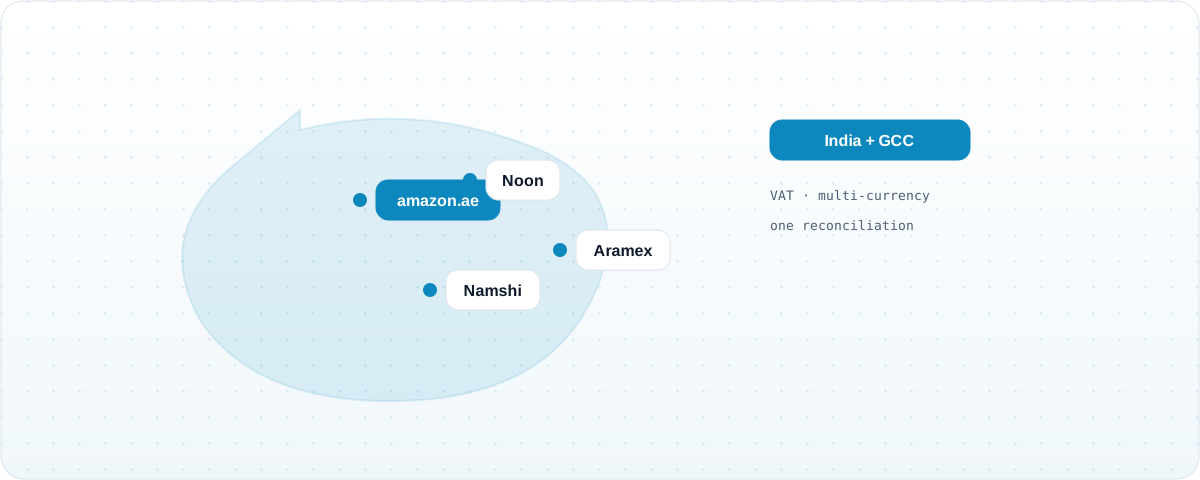
Most brands approach a Middle East launch as a commercial decision — pricing, listings, a distributor or a direct seller account — and treat operations as something the existing team absorbs.
That mostly works for the first few months, while volumes are small enough to handle by hand. It stops working at roughly the point the business becomes worth having.
Here is what actually differs.
Indian marketplace operations are built around a GST-shaped world: e-way bills, HSN codes, GSTR reconciliation, TDS and TCS.
The GCC has its own structure. VAT applies in the UAE and Saudi Arabia at rates and rules that are not GST, tax invoices carry different mandatory fields, and free-zone versus mainland entities are treated differently for import and VAT purposes. Saudi Arabia's e-invoicing regime has its own requirements entirely.
None of this is unusually difficult. It is simply a second rule set, and the practical consequence is that your validation logic cannot be shared blindly across regions. A PO validated against Indian tax masters will pass checks that are irrelevant and skip checks that matter.
Invoicing in AED or SAR while reporting in INR introduces a question that has to be answered deliberately: at what rate, and as of when?
The invoice, the settlement and the repatriation may all sit at different exchange rates. If your reconciliation books everything at a single period rate, you will produce variances that look like short payments but are exchange differences.
We have seen brands spend weeks chasing a channel over a "shortfall" that turned out to be a currency conversion booked on the wrong date. The fix is unexciting — record the rate at the transaction level, and reconcile in the transaction currency before converting — but it has to be designed in rather than retrofitted.
Your Indian carrier relationships do not extend. Aramex is the workhorse across the GCC, with strong coverage across the UAE, Saudi Arabia and the wider region.
The operational shape differs too. Cross-border movement introduces customs documentation and clearance time into a lane that is otherwise short. Intra-GCC delivery can be fast, but a consignment stuck in clearance is a delay with a completely different resolution path than a delayed domestic shipment — and your monitoring should be able to distinguish them.
Cash on delivery also remains significant in parts of the region, which changes both the settlement timeline and the return profile.
Noon, Namshi and amazon.ae each have their own PO formats, settlement cycles, deduction codes and dispute windows. Trendyol adds another set again.
The mistake is assuming that because your Amazon India integration works, amazon.ae is the same thing in a different currency. The marketplace mechanics are similar; the settlement structure and regional requirements are not.
Returns behave differently too. Fashion categories in the GCC — a large share of Namshi and Trendyol volume — carry return rates that will distort your planning if you have modelled on Indian benchmarks.
Not everything needs rebuilding. The core reconciliation logic is genuinely portable: a PO is still a PO, three-way and four-way matching still apply, and short supply is still short supply.
What has to be region-aware is the validation layer — the tax rules, currency handling and document requirements — and the connector layer.
This is the practical argument for running both regions on one platform rather than standing up a parallel process. Opptra operates across India, the Middle East and Southeast Asia on 20+ marketplaces, and consolidating that into one normalised view is what gave them same-day data freshness across 100k+ SKUs and 100+ hours saved monthly.
Two separate processes give you two sets of numbers that have to be reconciled with each other before anyone can see the business.
Worth answering before the first PO arrives, not after:
The last one sounds trivial and is the one most often forgotten. A monitoring setup routed to an Indian working day will find GCC problems several hours late, every day, permanently.
Tax and documentation move from a GST framework to VAT with region-specific invoice requirements, settlement happens in AED or SAR requiring multi-currency reconciliation, logistics runs through regional carriers such as Aramex with customs clearance on cross-border lanes, and each channel has its own settlement cycle and deduction codes.
Record the exchange rate at transaction level and reconcile in the transaction currency before converting for reporting. Booking everything at a single period rate creates variances that look like short payments but are actually exchange differences.
The core matching logic is portable — purchase orders, three-way and four-way matching and short-supply detection work the same way. What must be region-aware is the validation layer covering tax rules, currency and document requirements, plus the channel and carrier connectors.
Connect Noon, Namshi, amazon.ae and Aramex alongside your Indian channels, with reconciliation in both currencies.
Book a demo →
Scoring couriers on observed P90 delivery time and landed cost, so dispatch stops running on habit.

A finance view: why the close is too late to find problems, and what a live outstanding position actually requires.
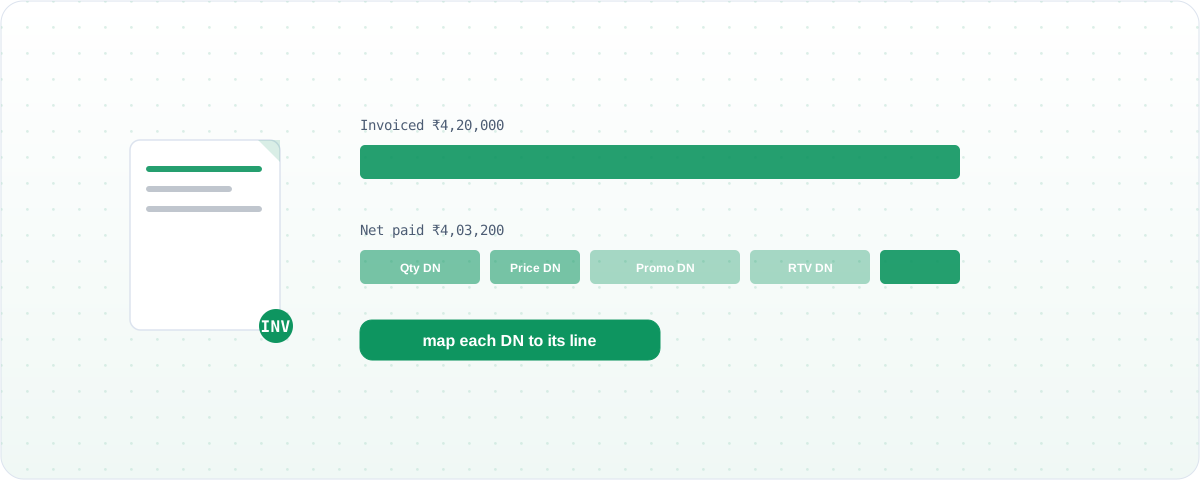
The main deduction categories, which are genuinely disputable, and the evidence pack each one needs before the window closes.